Anna Maria Island Flood Insurance: Why Elevation Certificates Matter
September 24, 2026
September 24, 2026
Six miles apart on the same seven-mile island, two piers are coming back from the 2024 hurricanes in almost opposite ways.
The Anna Maria City Pier is rising on public money. City commissioners approved a $4.6 million construction bid from Tampa Bay Marine, and the project carries a total budget between $7.14 million and $7.82 million, with funding that includes $3,597,653 from FEMA, $2 million in Manatee County tourist development tax revenue, and a $1.25 million state appropriation. By February 2026, the contractor had driven the walkway pilings and started cutting them to size. In June, the city commission signed GSM Partners to a new five year lease to reopen the pier restaurant, at $12,000 a month in base rent plus utilities and taxes, with increases tied to the consumer price index. Mayor Mark Short called the terms
"very fair"
at the June 11 meeting, adding that the new deal could save the city several thousand dollars a month over the old arrangement. The city is targeting a fall 2026 reopening.
A short drive north, the Rod and Reel Pier is coming back a different way. The pier had stood for more than 75 years when Helene and Milton hit it two weeks apart. Owner Oliver Lemke, who bought the business in November 2023, has said there was no insurance on the structure and no institutional backer behind the rebuild. What is funding the recovery is a GoFundMe campaign that had raised more than $104,000 toward a $300,000 goal as of May 2026, from nearly 1,000 individual donors.
That split, government-backed rebuild on one end of the island and crowdfunded rebuild on the other, is not just a story about piers. It is the same split running through every house you will look at on Anna Maria Island this year. Two homes can sit three doors apart, list at the same price, and carry insurance bills that differ by thousands of dollars a year, because one of them is built like the funded recovery and the other is built like the GoFundMe.
You do not need to look far past the piers to see the pattern repeat. Bradenton Beach building official Bill Palmer told The Anna Maria Islander in November that his department was still processing what he called a flood of rebuild permits more than a year after the storms. At the time, the most active file on his desk was the Bungalow Beach Resort at 2000 Gulf Drive N., a Gulf front property owned by Gayle Luper, who has operated the historic resort since 1999 and lost her beachfront cottages in 2024. Palmer said the owners could rebuild up to the original building volume, but any new structure has to meet current flood elevation standards, and the project architect was seeking a variance for additional volume beyond that. A few blocks over, the parking lot at Gulf Drive Cafe on Gulf Drive N. was working through its own review for stormwater compliance and access requirements before the redesign could move forward.
None of these owners are choosing whether to comply with flood elevation rules. The rules apply regardless of who is paying. What differs is how much room each owner has to work with, and that room is defined by the same document that will define yours if you buy here: the elevation certificate.
The City of Anna Maria confirms on its own site that the entire municipality sits inside the 100 year floodplain and is classified as a coastal high hazard area. That is not a marketing detail. It means flood insurance is a significant consideration for a financed purchase, and the price of that insurance is set property by property, not by the island as a whole.
According to Bradenton Herald reporting, flood insurance on Anna Maria Island currently averages $2,108 a year, with some policies quoted as high as $2,680 through the National Flood Insurance Program. That average is not where the story ends. Under FEMA's Risk Rating 2.0 system, premiums are being phased in toward what the agency considers each property's true risk based rate, and federal law caps how fast that phase in can happen: no more than 18 percent a year for a primary residence, and up to 25 percent a year for a second home, a business property, or a property with a history of repeat flood losses. The same Bradenton Herald reporting notes that the average premium on the island is projected to reach $5,793 within the next decade, a 175 percent increase from today.
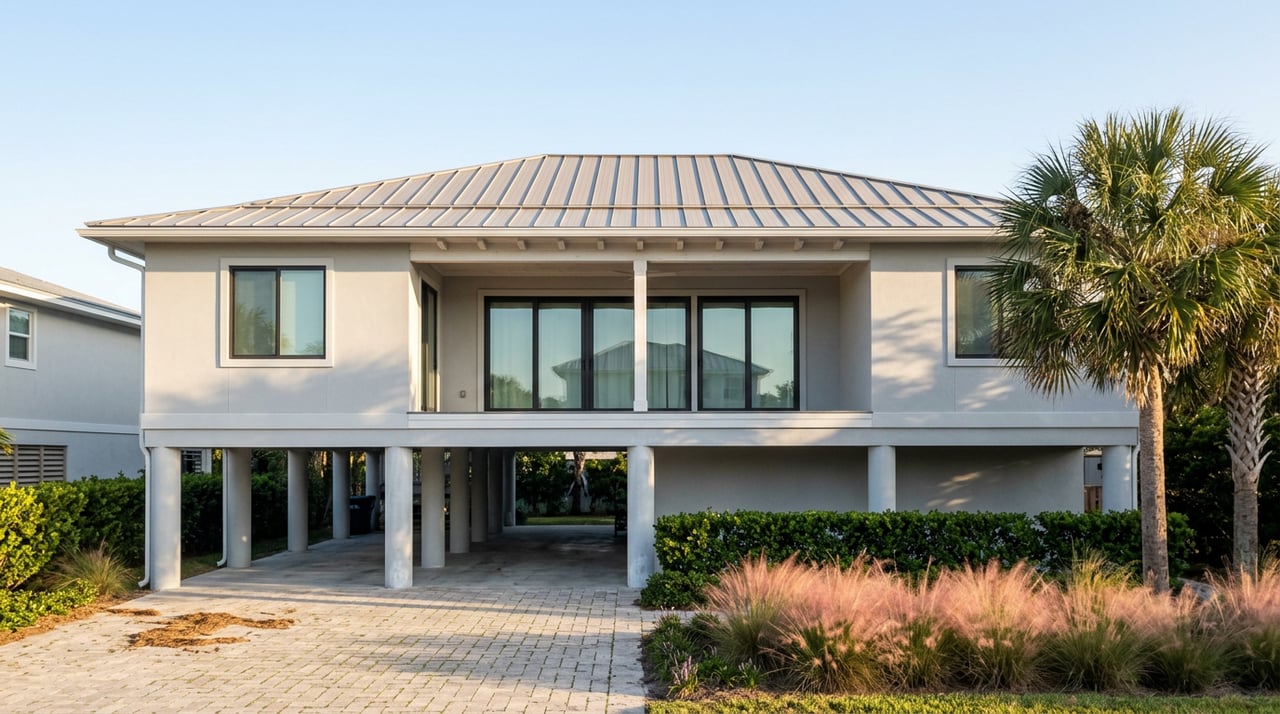
Here is what that means in practice. A ground level cottage without a current elevation certificate may start from a higher number. The annual increase cap depends on the property's category under the rules, not simply on its elevation. A newer home built above base flood elevation may start lower or may already be priced closer to its true risk rate today. Two houses with the same square footage and the same list price can be on completely different trajectories, and an elevation certificate can help show how a property's risk is assessed.
This is not theoretical. When FEMA's newer rating methodology first rolled out, The Anna Maria Islander reported that some single family homes on the island faced first year premium increases of up to $1,200, among the steepest jumps anywhere in the country, while others on the same island barely moved. The variance was already there in 2021. The storms in 2024 widened it.
| Elevated, current certificate | Ground level, no recent certificate | |
|---|---|---|
| Starting point | At or near the island average of $2,108/year | Often well above average today |
| Annual increase cap (primary residence) | 18% | 18%, but starting from a higher base |
| Annual increase cap (second home) | 25% | 25%, compounding faster on a higher base |
| Renovation exposure | Lower risk of triggering full flood-code compliance | Higher risk of triggering FEMA's substantial improvement rule |
The elevation certificate matters again the moment you or a future owner wants to do meaningful work on the house. According to Revolution Florida, under the National Flood Insurance Program's substantial improvement rule, once the cost of a renovation or repair reaches or exceeds half the structure's pre improvement market value, the entire building has to be brought up to current floodplain standards. Manatee County's floodplain management office administers this rule locally and can confirm how it applies to a specific parcel before you buy.
The November report on the Bungalow Beach Resort illustrates exactly this fork. An owner who wants to rebuild larger than the original footprint has to negotiate a variance, because the elevation standard is not something a permit application can talk its way around. A buyer who picks up a storm damaged cottage assuming a light cosmetic refresh can find out during permitting that the number on the invoice has crossed the substantial improvement threshold, and now the project includes raising the house.
Does paying cash mean I can skip flood insurance? Whether you pay cash or finance, flood insurance is worth considering. Going without it on a barrier island exposed to Gulf storm surge is a bet most owners choose not to make, insured or not.
Is the flood zone label on a map enough to judge a property? Not by itself. Two homes in the same FEMA zone can carry very different premiums depending on the elevation certificate, the age of the structure, and how the lowest floor sits relative to base flood elevation. The zone tells you the neighborhood's risk category. The certificate tells you the house's actual number.
If a home already has hurricane damage disclosed, does that automatically trigger the 50 percent rule? Not automatically. It depends on whether the documented repair or improvement cost reaches half the structure's pre improvement market value. That is a calculation worth running with your agent and the county's floodplain office before you assume either outcome.
The city's pier is being rebuilt with several identified funding sources and a signed contractor. The Rod and Reel Pier is being rebuilt one donation at a time. Neither approach is wrong, but they are not the same, and the same is true of the houses between them. Before you compare two listings on price, compare their elevation certificates. That is the number that tells you what you are actually buying.
If you are weighing a purchase on Anna Maria Island or anywhere else across Manatee and Sarasota counties, the Echo Belser Team can walk the elevation certificate and insurance math with you before you write an offer, not after. Start with a free, instant home valuation or browse our Anna Maria Island neighborhood guide to see what is currently on the market.
This article is general information, not legal, tax or financial advice. Consult a qualified professional about your situation.
We bring together a mix of integrity, imagination and an inexhaustible work ethic, striving to make each buying and selling experience the best possible.
Get In Touch With Our Team To Learn More

ECHO BELSER TEAM
11215 STATE ROAD 70 E UNIT 105 LAKEWOOD RANCH FL 34202