The HOA Fee Isn't the Number That Decides Country Creek vs. Greyhawk Landing
October 1, 2026
October 1, 2026
A buyer cross-shopping half-acre lots east of I-75 on the SR-64 corridor will find Country Creek and Greyhawk Landing within a few minutes of each other, both marketed on the same promise: space, mature trees, and distance from anything that feels like a subdivision. The list prices tell one story. The annual assessment schedules tell a different one, and it's the second story that actually decides what these homes cost to own over a decade, not five years.
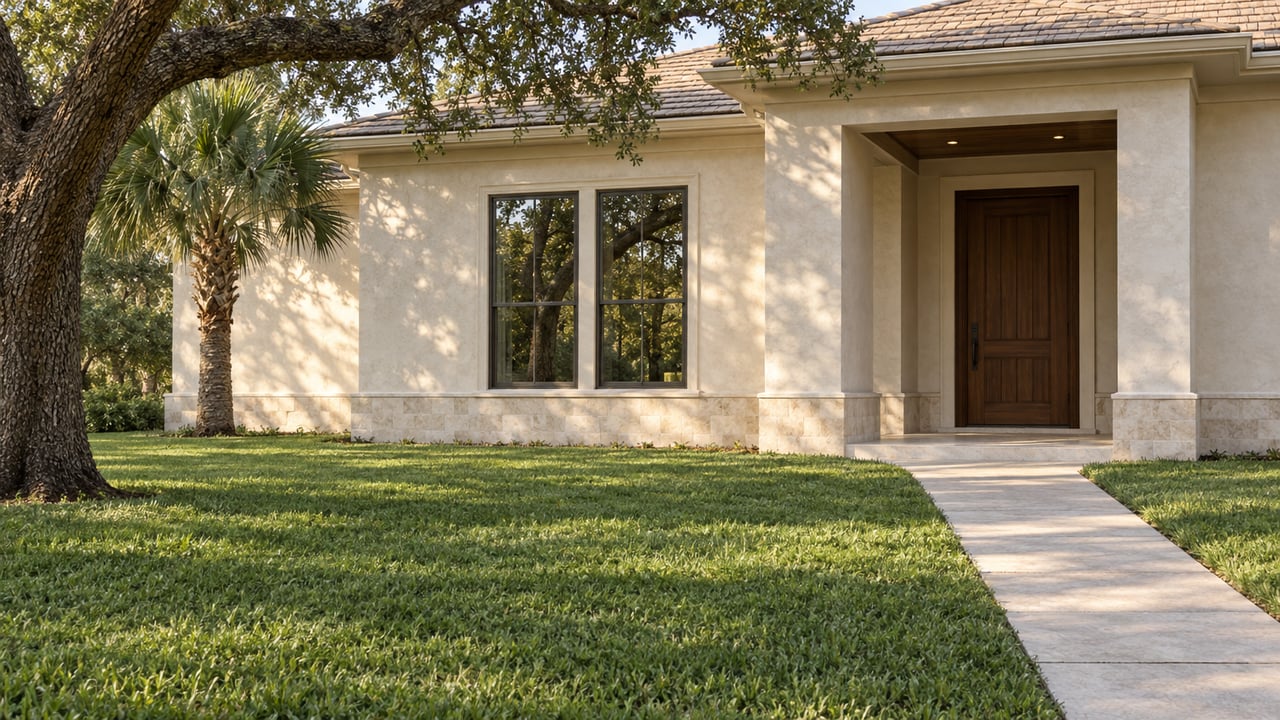
Country Creek sits about six miles east of I-75 off State Road 64, near Lake Manatee State Park. It's a small, established neighborhood, fewer than 80 single-family homes on lots that run from a half acre to a full acre, built mostly through the 1990s. The streets have sidewalks, a lake, boardwalks, and bike paths that wind past ponds where residents fish and watch birds. It reads as quiet on purpose. Roughly 1,400 people live there.
Greyhawk Landing is a different kind of build entirely. It's a 960-acre gated community also off SR 64 East, developed in phases from the early 2000s through recent years by a mix of builders, including D.R. Horton, Homes by Towne, Sam Rodgers Homes, Lennar, and Arthur Rutenberg Homes for the custom lots in Phase 3. Roughly 1,271 units sit behind a 24-hour manned gate, spread across subdivisions with names like Deerwalk, Eagle Run, and Falcon Trace. The amenity list runs long: two clubhouses, a lagoon-style pool with a spa and slides, a fitness center, lighted tennis and basketball courts, ball fields, a fishing dock, and close to two miles of walking and biking trails through preserved green space.
On paper, both communities sell the same pitch to the same buyer: room to spread out near Lakewood Ranch without paying Lakewood Ranch prices. The math underneath is where they split.
Country Creek charges a flat annual HOA fee of $581. There is no Community Development District attached to the property, so that figure is close to the whole story for community costs.
Greyhawk Landing charges an HOA fee too, around $50 a year, which sounds almost nominal next to Country Creek's number. But Greyhawk Landing also carries a CDD assessment, and that's where the real gap opens up. Based on the FY 2025-2026 Manatee County budget, the CDD assessment runs $2,234 to $3,798 per year depending on lot size, funding a total district budget of roughly $2.36 million across those 1,271 units. Add the HOA on top and total community costs land somewhere between $190 and $321 a month.
Put another way: a buyer choosing between a Country Creek home and a Greyhawk Landing home at similar price points isn't just weighing square footage and finish level. They're weighing a $581 annual bill against one that could run north of $4,000 a year once both assessments are counted.
The instinct with most housing costs is that they behave like a mortgage: you chip away at the balance, and the payment either goes away or gets smaller as you build equity. A CDD assessment doesn't work that way.
The debt portion of a CDD assessment funds specific bonds the district issued to build its infrastructure and amenities, and those bonds run on a fixed schedule that has nothing to do with any individual owner's tenure. Greyhawk Landing's CDD carries two bond series: the Series 2011 bonds mature on May 1, 2033, and the Series 2013 bonds, which financed the GreyHawk West portion of the development, mature on May 1, 2044. According to the district's own finance disclosures, the debt assessment is a fixed amount that does not change from year to year, while a separate operations and maintenance assessment can move up or down annually based on the district's adopted budget.
That means a buyer who closes on a Greyhawk Landing home in 2030 pays the same annual debt assessment as a buyer who closed in 2012, right up until the bonds are retired. There's no amortization curve working in the newer buyer's favor. The clock is attached to the bond, not to the purchase date.
Country Creek was built before CDD financing became standard practice for master-planned communities in this part of Manatee County, and it never took on that kind of debt. That's the tradeoff hiding behind the HOA fee comparison: Country Creek's low number reflects a community that never built (or financed) a clubhouse, a gated entrance, or a lagoon pool. Greyhawk Landing's higher number is paying down exactly those things, on a schedule that runs into the 2040s regardless of who owns the house.
None of this makes Greyhawk Landing a worse deal. It makes it a different kind of deal, and the amenity list explains why some buyers pay for it happily. A 24-hour manned gate, two clubhouses, a resort-style pool complex, sports courts, and a maintained trail network are real infrastructure with real upkeep costs, and CDD financing is a standard, transparent way Florida communities fund that kind of build-out. Country Creek residents get a quieter, lower-cost version of half-acre living: a community pool, a lake, walking paths, and not much else in the way of programmed amenities.
The choice between the two isn't about which fee structure is objectively better. It's about matching the assessment to what a buyer actually wants to use. A family that will use the pool, the courts, and the trails every week is paying for utilization. A family that wants a quiet, low-maintenance half-acre and doesn't plan to touch a clubhouse is paying overhead for someone else's amenities.
As of August 2026, Bradenton's overall housing market shows a median sale price around $410,000, with homes taking about 88 days to sell on average, a slower pace than the prior year that has given buyers more room to negotiate across the city. Greyhawk Landing specifically has followed that same direction: the community's median sale price sits around $687,000 to $729,000 as of mid-2026, and days on market there have stretched to roughly 128, up from the 40-day pace that defined the 2021-2022 rush. That shift matters for anyone weighing the CDD math, because a slower market gives buyers more standing to ask sellers about assessment schedules, request the current CDD budget documents, and factor the fixed debt payment into an offer rather than treating it as a footnote discovered at closing.
Country Creek's inventory is thin by comparison, simply because there are so few homes in the neighborhood to begin with. When one does come up, the flat $581 HOA fee tends to be one of the more straightforward numbers in the transaction, with no separate CDD budget to pull or bond schedule to check.
Does Country Creek have any CDD exposure at all? No. The community predates CDD financing in this stretch of Manatee County, and the only recurring community cost is the HOA fee.
Can a Greyhawk Landing CDD assessment be paid off early? Yes, in some cases. The district's finance office handles bond payoff quotes for owners who want to satisfy the remaining debt assessment in a lump sum rather than paying it annually through the property tax bill. That's a conversation worth having with the CDD directly before assuming it's fixed forever for your specific lot.
Does a higher CDD assessment mean a home is overpriced? Not on its own. It means part of the carrying cost is funding infrastructure and amenities rather than sitting inside the mortgage. Whether that's a fair trade depends on how much a buyer will actually use what the assessment pays for.
If you're weighing Country Creek's flat HOA bill against Greyhawk Landing's CDD math, or trying to figure out how either number affects what you could actually afford on the SR-64 corridor, Echo Belser Team can pull the current assessment schedule for any address you're looking at and set it next to what your current home would sell for today. Request your free, instant home valuation and we'll start there.
We bring together a mix of integrity, imagination and an inexhaustible work ethic, striving to make each buying and selling experience the best possible.
Get In Touch With Our Team To Learn More

ECHO BELSER TEAM
11215 STATE ROAD 70 E UNIT 105 LAKEWOOD RANCH FL 34202